
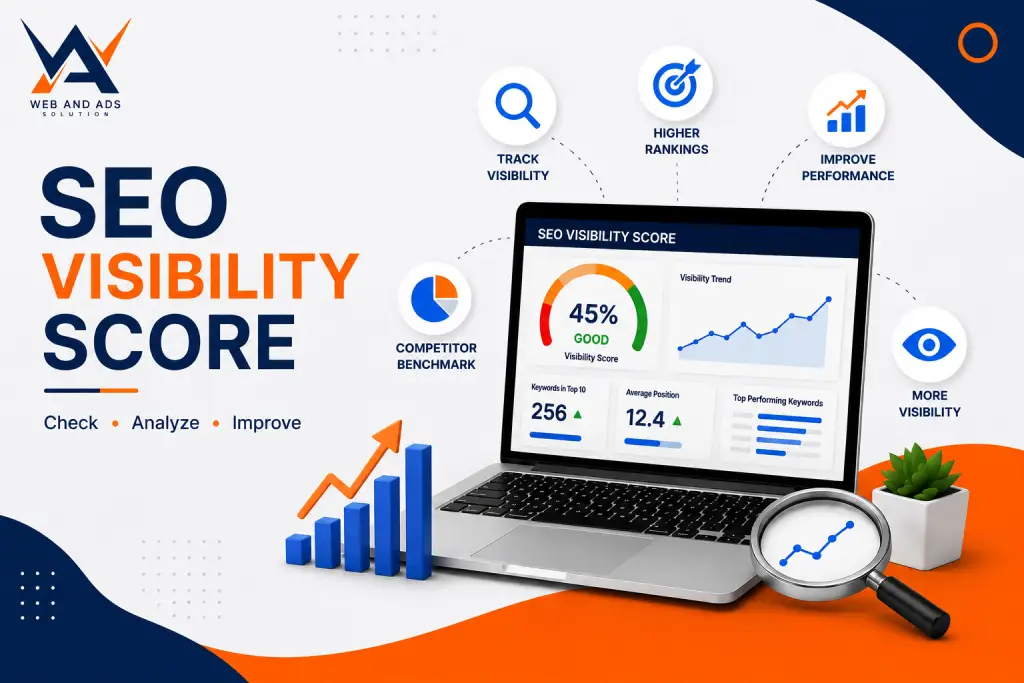
If you've pulled up a rank-tracking dashboard and seen a "visibility score" staring back at you, you've probably asked the obvious question: is this number good or bad? The short answer is that a visibility score between 31% and 50% is generally considered good, and anything above 50% puts you in a dominant, top-of-market position. But the full answer is more nuanced than a single range, and understanding why matters just as much as knowing the benchmark
This guide breaks down what an SEO visibility score actually measures, what counts as a good one, and the specific tactics that move the needle— the same fundamentals we apply across our SEO services.
What Is an SEO Visibility Score?
An SEO visibility score is a percentage that estimates how likely searchers are to see and click your website in organic (unpaid) search results across a set of target keywords. It's worth noting this is distinct from paid visibility, which falls under PPC advertising rather than organic SEO.
It's typically calculated by a rank-tracking tool — Semrush, Ahrefs, Moz, and similar platforms all offer a version of it — and the math usually blends together a few inputs:
- Your ranking position for each tracked keyword
- Search volume for those keywords
- Expected click-through rate based on position (a #1 ranking captures far more clicks than a #8 ranking)
The resulting score gives you a single, easy-to-track number instead of having to mentally juggle dozens or hundreds of individual keyword rankings.
Three reference points make the scale easy to understand:
- 100% visibility means you rank #1 for every keyword you're tracking
- 50% visibility means you're capturing roughly half of the maximum possible visibility for your keyword set
- 0% visibility means you aren't ranking for any of your tracked keywords
Also Read: Digital Marketing Guide
Good SEO Visibility Score with Range
A good SEO visibility score generally falls between 31% and 50%, indicating consistent page-one rankings across most of your target keywords. A score above 50% is considered very good to exceptional and signals a dominant position in your niche. Scores under 15% suggest your site has low to moderate visibility and real room to grow.
Here's the full breakdown:
| Score Range | Rating | What It Means |
|---|---|---|
| 0–10% | Low | Site is new or barely ranking for tracked keywords |
| 11–30% | Fair / Moderate | You show up in results, but competitors regularly outrank you |
| 31–50% | Good | Consistent page-one rankings across many target terms |
| 51%+ | Very Good / Exceptional | Dominant, top-of-market presence in your niche |
It's worth being upfront about something most benchmark tables leave out: hitting even 30–40% is genuinely difficult once you're in a competitive market. Even large, well-resourced companies in crowded industries rarely sustain scores above that range — a 100% score is close to a theoretical ceiling, not a realistic target.
Why "Good" Depends on Your Competitors, Not Just the Number
The benchmark table above is a useful starting point, but a raw percentage without context can be misleading. A 15% visibility score sounds unimpressive in isolation — but if your closest competitors are sitting at 8–12%, you're actually winning in your market.
The reverse is also true: a 35% score might look "good" on a benchmark chart, but if competitors in your space are averaging 45–55%, you're falling behind despite technically landing in the "good" range.
That's why the most useful way to evaluate your score isn't against a universal chart — it's against your own industry and your own direct competitors. A few things to keep in mind:
- Competitive markets compress the ceiling. In highly contested industries like e-commerce, finance, or legal, even market leaders may only reach 30–40%. In a smaller or less competitive niche, a similar score could mean you're the clear leader.
- Your keyword set shapes the number. A visibility score is only as meaningful as the keywords you're tracking. Broad, high-volume keywords behave differently than a tightly focused, long-tail list.
- Adding keywords will temporarily lower your score. If you expand your tracked keyword list with new terms you haven't ranked for yet, expect a dip — that's a tracking artifact, not a sign of declining performance.
- Track the trend, not just the snapshot. Watching your score move over months (and comparing that trend line to competitors) tells you far more than any single data point.
Also Read: Why an SEO Audit Is Important
Is 75 a Good SEO Visibility Score?
Yes. A visibility score of 75% is exceptional and would place a site firmly in dominant, market-leading territory. In practice, scores this high are rare outside of low-competition niches or for brands with very strong, long-established authority in their space — most businesses, even successful ones, operate well below this threshold.
What Is Considered a Good SEO Score?
This depends on which "SEO score" is being referenced, since the term gets used two different ways:
- SEO visibility score measures how often and how prominently you appear in organic search results for your target keywords — this is the metric covered throughout this guide, and a good score typically falls in the 31–50%+ range.
- SEO health/audit score (sometimes just called an "SEO score") measures technical site health — things like page speed, crawlability, broken links, and on-page optimization. Tools like Semrush's Site Audit or similar platforms usually score this out of 100, and anything above 80–90 is generally considered strong.
If you're unsure which one you're looking at, check the tool generating the number — visibility scores are almost always expressed as a percentage tied to keyword rankings, while health/audit scores are usually a flat number out of 100 tied to technical checks.
What Is the 80/20 Rule in SEO?
The 80/20 rule in SEO (a version of the Pareto Principle) suggests that roughly 80% of your organic search results — traffic, rankings, or visibility — tend to come from about 20% of your content, pages, or keywords. In practice, this means a small subset of your best-performing pages usually drives the bulk of your SEO value, while the majority of your content contributes comparatively little. It's a useful lens for prioritization: identifying and doubling down on that high-performing 20% (through further optimization, internal linking, or content refreshes) is often more efficient than spreading effort evenly across an entire site.
What Affects Your SEO Visibility Score?
Since visibility is fundamentally tied to rankings, anything that affects where you rank affects your visibility score. Search engines evaluate relevance, quality, and usability relative to what a searcher is looking for — and higher-ranking pages naturally earn higher click-through rates, which compounds the visibility effect.
Beyond core rankings, a few other factors shape the number:
- Search volume of your tracked keywords — ranking #1 for a high-volume term contributes more to your score than ranking #1 for a rarely searched one
- Actual or expected click-through rates by position, which vary depending on how the tool calculates the metric
- The size and composition of your keyword list — a narrow, highly-targeted list behaves very differently than a broad one
Each of these levers is something a dedicated SEO strategy can actively manage rather than leaving to chance.
Also Read: What Is Social Media Marketing?
How to Improve a Low Visibility Score
If your score is lower than you'd like, here's where to focus effort:
1. Prioritize keywords you're already ranking in positions 2–12.
Movement within this range tends to produce the biggest visibility gains, because you've already established enough relevance and authority to compete — the goal is simply to edge past one or two more competitors. Look for pages with several keywords clustered in this range rather than optimizing one keyword at a time; you can often improve multiple rankings with a single round of updates. Tactics that help here include strengthening content quality, building backlinks to the page, adding internal links with keyword-relevant anchor text, and tightening up on-page SEO.
2. Go after low-difficulty keywords.
Terms with weaker competition are comparatively easier to rank for and can add visibility more efficiently than chasing highly contested head terms. Most keyword research tools surface a difficulty score — filtering for the easier end of that range, then layering in relevance and search volume, helps you build a realistic target list.
3. Optimize for SERP features, not just the ten blue links.
Search results pages increasingly include features like AI Overviews, People Also Ask boxes, image packs, and knowledge panels — and ranking within these can capture visibility even before a searcher scrolls to standard organic results. Structuring content with clear headings, direct answers near the top, descriptive image alt text, and schema markup all improve your odds of appearing in these features.
4. Invest in technical SEO fundamentals.
Page speed, crawlability, mobile-friendliness, and clean site architecture all influence whether search engines can properly index and rank your content in the first place — no amount of content quality compensates for a site that's technically difficult to crawl. This is often where website development work and SEO strategy need to work hand in hand.
5. Build backlink authority.
Earning links from relevant, authoritative sites in your industry continues to be one of the strongest ranking signals, and by extension, one of the more reliable ways to lift visibility over time.
6. Build brand awareness.
A stronger brand tends to earn more branded searches (which you're likely to rank #1 for consistently) and can improve how search engines perceive your overall authority. Digital PR, a clear brand identity, and consistent social media marketing all contribute here — our SMO services are built around exactly this kind of visibility-building.
Also Read: What Is a Virtual Assistant?
How to Check Your SEO Visibility Score
Most major SEO platforms include a visibility metric as part of their rank-tracking tools:
- Semrush — calculated within the Position Tracking tool, weighted by keyword-specific click-through rates
- Ahrefs — offers a similar visibility metric tied to tracked keyword rankings
- Moz — provides a comparable search visibility score within its rank-tracking suite
Most of these tools also let you add competitor domains directly into your tracking campaign, so you can watch your visibility score trend against theirs over time rather than evaluating it in isolation — which, as covered above, is the more meaningful way to interpret the number.
Also Read: What Is an AI Virtual Assistant?
Frequently Asked Questions
What is the visibility score in SEO?
It's a percentage metric that estimates how often and how prominently your website appears in organic search results for a defined set of target keywords, based on ranking position, search volume, and expected click-through rates.
Is 75 a good SEO score?
Yes — a 75% visibility score is exceptional and indicates a dominant market position, though scores this high are uncommon outside low-competition niches.
What's a good Google visibility score vs. a Semrush visibility score?
They're generally referring to the same underlying concept of visibility in Google's organic search results — but the exact calculation can vary slightly by tool depending on how each platform weights click-through rates and search volume. Benchmarks in the 31–50%+ range apply broadly across most rank-tracking platforms.
Does a low visibility score always mean poor SEO performance?
Not necessarily. A lower score can still represent market leadership in a smaller or less competitive niche, and can also dip temporarily simply from adding new, untested keywords to your tracking list. Context, especially how you compare to direct competitors — matters more than the raw number.
Want a clearer picture of where your site stands? A visibility audit compares your current score against your direct competitors and identifies the fastest opportunities to close the gap. Get in touch for a free strategy call.