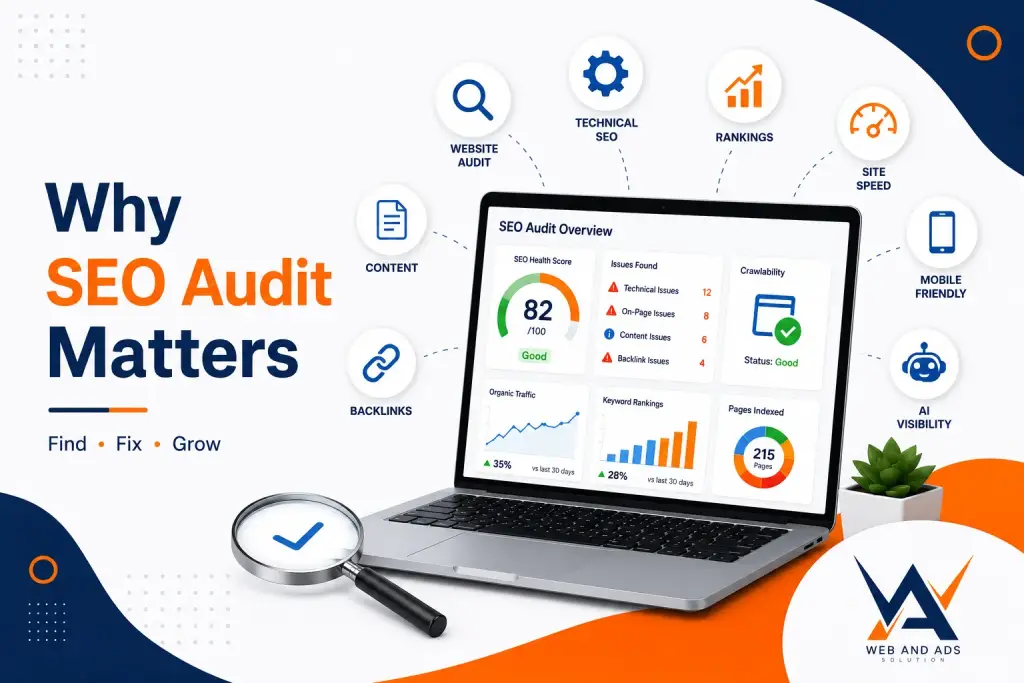
An SEO audit is important because it's the only way to find the technical, content, and backlink problems that are quietly capping your rankings problems you can't see just by looking at your website.
Most site owners assume their SEO issues will show up somewhere obvious. A warning in Google Search Console. A sudden traffic crash. Something dramatic.
They usually don't.
In our experience, most ranking problems are slow leaks, not blowouts. A page that used to load in 2 seconds now takes 5. A blog post that ranked in 2023 is quietly outdated. A handful of backlinks from spammy directories nobody remembers building.
None of that trips an alarm. It just costs you traffic, month after month, until you finally ask why.
Whether you're looking for quick technical fixes or targeted seo help for small business growth, an experienced seo specialist uses an audit as the starting point to uncover what's actually holding your site back.
Also Read: What Is Digital Marketing
5 Reason Why SEO Audit Is Important:
1. It Finds Problems You Genuinely Can't See By Looking
You can visit your own website every day and never notice that a plugin update broke your sitemap. Or that a redirect chain is quietly draining your page authority.
Claim: most SEO issues are invisible to the naked eye. Evidence: Google's own Search Central documentation explains that crawling, indexing, and ranking depend on dozens of technical signals most site owners never check manually. Why it matters: if you're not actively looking for these signals, you won't find them until they've already hurt your rankings.
2. It Stops You From Wasting Money on Marketing That Can't Convert
Here's a pattern we've seen repeatedly: a business spends heavily on content or ads, driving traffic to a site with a 6-second load time or a broken checkout flow. The traffic arrives. It leaves just as fast.
Modern seo marketing has to check for this new landscape, ensuring your site isn't just optimized for traditional blue links, but structured to win visibility in AI-driven search results.
3. It Keeps You Aligned With How Search Actually Works Now
Search isn't just "type a keyword, get 10 blue links" anymore. Google's AI Overviews summarize answers directly. People ask ChatGPT questions instead of Googling them.
When we test client sites against this shift, the pattern is consistent: sites with clear structure, direct answers, and well-organized content get pulled into AI-generated answers far more often than sites written the old way: long intros, vague headers, no direct answers up top.
An audit today has to check for this, not just traditional ranking factors.
4. It Gives You a Baseline to Measure Progress Against
You can't tell if your SEO is improving if you don't know where you started.
An audit is your "before" photo. Every change you make afterward content updates, technical fixes, new backlinks gets measured against that baseline. Without it, you're just guessing whether things are getting better.
5. It Shows You Exactly What Your Competitors Are Doing Right
Auditing isn't limited to your own site. Looking at what's ranking above you, their content structure, their backlink sources, their site speed tells you what the bar actually is in your market, not what you assume it is.
Also Read: What Is Social Media Marketing
What Is an SEO Audit and its Meaning
An SEO audit is a full check-up of your website's technical setup, content, and backlinks to find what's helping you rank and what's holding you back.
Think of it like a car inspection. (Not the most original comparison, we know but it's accurate.) You don't wait for the engine to fail before checking the oil. A good mechanic checks everything, tells you what's urgent, and what can wait.
An SEO audit works the same way. It looks at three main areas:
|
Audit Area |
What It Checks |
Why It Matters |
|
Technical SEO |
Site speed, mobile-friendliness, crawlability, indexing, security (HTTPS), broken links |
Google can't rank a page it can't crawl or load properly |
|
On-page & Content |
Meta titles/descriptions, headers, keyword alignment, content quality, search intent match |
Determines whether your content actually answers what people are searching for |
|
Off-page & Backlinks |
Link quality, toxic/spammy backlinks, domain authority |
Signals trust and authority to search engines |
A growing fourth area matters too now: AI and answer-engine readiness whether your content is structured clearly enough for tools like Google's AI Overviews or ChatGPT to reference it. We'll come back to that later, because it's changing faster than most audits account for.
Note: People sometimes use "SEO audit" and "site audit" interchangeably. They're close enough a site audit is usually just a slightly broader term that can include UX and conversion elements alongside pure SEO factors.
Benefits of an SEO Audit
Beyond the "why," here's what you actually walk away with:
-
Higher rankings and visibility because you're fixing the things actually holding pages back, not guessing
-
Better crawlability and indexing so Google can find and understand all your important pages
-
Improved conversions fixing speed and UX issues keeps visitors around long enough to act
-
A clear content gap list showing you exactly what topics competitors cover that you don't
-
A cleaner backlink profile with toxic or spammy links flagged for removal
-
A measurable starting point so every future change can be tracked against real data
Pro Tip: Don't try to fix everything an audit finds at once. Prioritize technical issues first (crawling, indexing, speed) content and backlink fixes land better once the technical foundation is solid.
Signs You Need an SEO Audit
Not sure if this applies to you? These are the signals we tell clients to watch for:
-
Your traffic dropped suddenly and you don't know why
-
Rankings are stuck despite publishing content regularly
-
You recently redesigned or migrated your site a common time for things to quietly break
-
Bounce rate is high visitors arrive and leave almost immediately
-
It's been 6–12 months since your last audit (or you've genuinely never had one)
If two or more of these sound familiar, that's not a coincidence. It's usually time.
[IMAGE: A simple checklist-style graphic listing the five warning signs above, with checkboxes] Caption: Five signs it's time for an SEO audit check how many apply to your site. Alt text: Checklist of warning signs indicating a website needs an SEO audit
How Often Should You Audit Your Site?
This depends on how competitive your space is and how often your site changes.
-
Competitive industries (legal, healthcare, e-commerce): every 3 months
-
Smaller or less competitive sites: twice a year is usually enough
-
After anything major: a redesign, a migration, a big algorithm update, or a sudden traffic drop audit immediately, don't wait for the scheduled check-in
DIY vs. Professional Audit: Tools, Time, and Cost
Can you do an SEO audit yourself? Yes, but only up to a point.
Free tools that get you started:
-
Google Search Console (indexing issues, search performance)
-
PageSpeed Insights / Core Web Vitals reports (speed and UX)
Paid tools professionals typically use:
-
SEMrush and Ahrefs for backlink and competitor analysis
-
Screaming Frog for full technical crawls
The honest truth: DIY tools are great for spotting that something's wrong. They're less good at telling you what to prioritize and how to fix it correctly, especially technical issues that require code-level changes.
That's usually the point where the cost of a professional audit pays for itself. It's almost always cheaper than continuing to spend on content or ads that a broken site can't convert.
If budget is the concern, it's worth looking at affordable SEO plans built for small businesses rather than assuming a proper audit is out of reach most agencies, us included, scale audit depth to what a smaller site actually needs.
Can AI Tools Do an SEO Audit?
Yes But Tools like ChatGPT can scan a page and flag obvious issues such as missing meta tags, thin content, awkward structure. That's genuinely useful as a first pass.
What AI can't do well yet is prioritize those issues based on your specific industry, competition, and business goals or make the technical fixes that require actual development work.
In our projects, we treat AI as a first-pass scanner, not the final word. It speeds up the discovery stage. A person still needs to decide what matters most and execute the fix.
This is also exactly where AI visibility work comes in making sure your site isn't just optimized for traditional Google rankings, but structured so tools like ChatGPT and AI Overviews can actually reference and recommend you. It's a newer layer on top of a standard audit, not a replacement for one.
Further Reading: If you want to understand this shift in more depth, our AEO and GEO services page breaks down how answer-engine and generative-engine optimization differ from traditional SEO.
Common Mistakes People Make With SEO Audits
Auditing once and never again. An audit is a snapshot, not a permanent fix. Sites drift out of shape as content ages and technical debt builds up.
Fixing everything at once, in no particular order. This burns time and budget on low-impact changes while high-impact technical issues sit untouched.
Ignoring the AI/answer-engine layer. Many audits still only check traditional ranking factors. We've seen sites pass a "clean" technical audit and still be invisible in AI Overviews, simply because content wasn't structured to be quotable.
Treating the audit as the finish line. The audit tells you what's wrong. The value only shows up once you act on the findings.
Should You Hire an Agency for This?
If your site is small, your niche isn't competitive, and you have the time to learn the tools DIY can genuinely work.
If you're managing a growing business, competing in a crowded market, or simply don't have hours to spend learning Screaming Frog crawls, it usually makes more sense to bring in a digital marketing agency that does this full-time.
What to look for either way: someone who explains findings in plain language, prioritizes fixes instead of dumping a 40-page report on you, and actually tracks progress afterward not just a one-time PDF.
FAQs
What is SEO auditing?
It's a structured review of your website's technical setup, content, and backlinks to find what's helping or hurting your search rankings.
Can I do my own SEO audit?
Yes, using free tools like Google Search Console and PageSpeed Insights. It works well for basic checks; deeper technical or backlink analysis usually benefits from professional tools and experience.
What are the top SEO audit tools?
Google Search Console, PageSpeed Insights, Screaming Frog, SEMrush, and Ahrefs are the most commonly used across the industry.
Can ChatGPT do an SEO audit?
It can flag obvious issues like missing meta tags or thin content, but it can't prioritize fixes based on your specific business context or execute technical changes.
How much does an SEO audit cost?
It varies widely based on site size and depth of analysis. Many agencies offer tiered or affordable packages scaled for smaller sites.
How often should I audit my site?
Every 3 months for competitive industries, twice a year for smaller sites, and immediately after any major site change or traffic drop.
The Bottom Line
An SEO audit isn't a formality, it's how you find out what's actually happening on your website instead of guessing. Skip it, and you're optimizing blind.
If you've read this far and you're pretty sure it's been too long since your last audit (or you've never had one), that's worth acting on now rather than later the longer issues sit unresolved, the more traffic they quietly cost you.
We're Web and Ads Solution, a full-service digital marketing agency based in Harrisonville, Missouri, and we've spent over 10 years running SEO audits for more than 350 brands from local businesses to companies competing nationally. Our process starts with exactly this: understanding your site, researching what's actually holding it back, and building a plan around what we find, including how it shows up in AI-driven search, not just traditional rankings.
If you want a second set of eyes on your site, book a free strategy call and we'll walk you through what an audit would actually look like for your business. No pressure, no jargon, just a straight answer about where you stand.